
What Is a Mud Pump and How Does It Work?
Understand the mud pump working principle, main components, duplex and triplex designs, drilling applications, and equipment selection considerations.
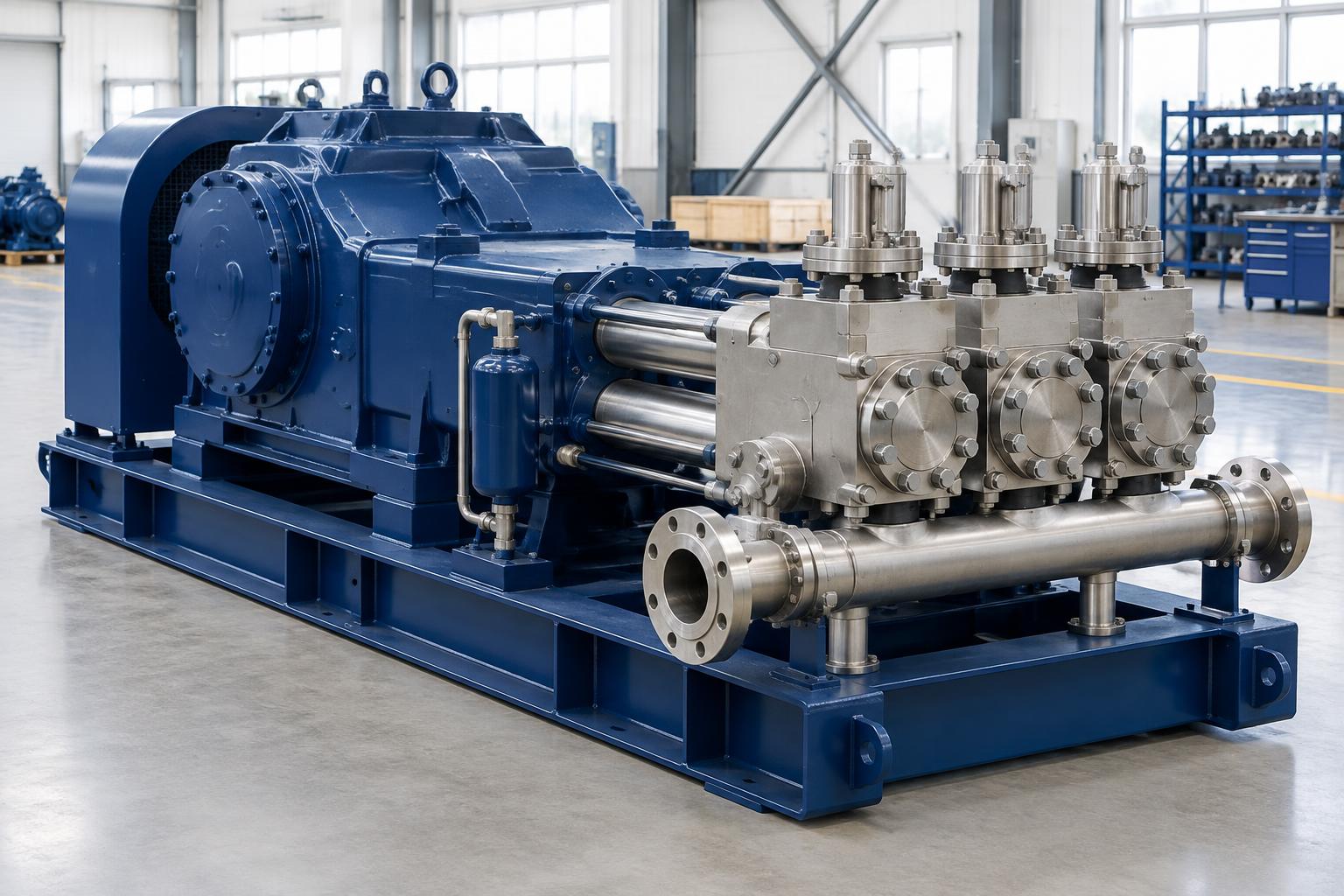
What Is a Mud Pump?
A mud pump is a heavy-duty reciprocating positive-displacement pump used to circulate drilling fluid, commonly called drilling mud. It draws fluid from the surface mud system and sends it through the high-pressure discharge line, standpipe, rotary hose, and drill string.
The fluid exits through the drill bit and returns to the surface through the annulus between the drill string and the wellbore. At the surface, solids-control equipment removes cuttings before the fluid is recirculated.
This continuous circulation transports cuttings, cools and lubricates the bit, and helps support wellbore stability. Drilling-fluid density provides hydrostatic pressure; the mud pump supplies the pressure needed to overcome friction and other losses in the circulating system.
Mud Pump Working Principle
The mud pump working principle is based on changing the volume of a pumping chamber. A motor or engine drives the power end, where a crankshaft and connecting rods convert rotary motion into the reciprocating movement of pistons or plungers.
Suction stroke
As the piston retracts, chamber volume increases and pressure inside the cylinder falls below the suction supply pressure. The suction valve opens, allowing drilling fluid to enter. The discharge valve remains closed.
Discharge stroke
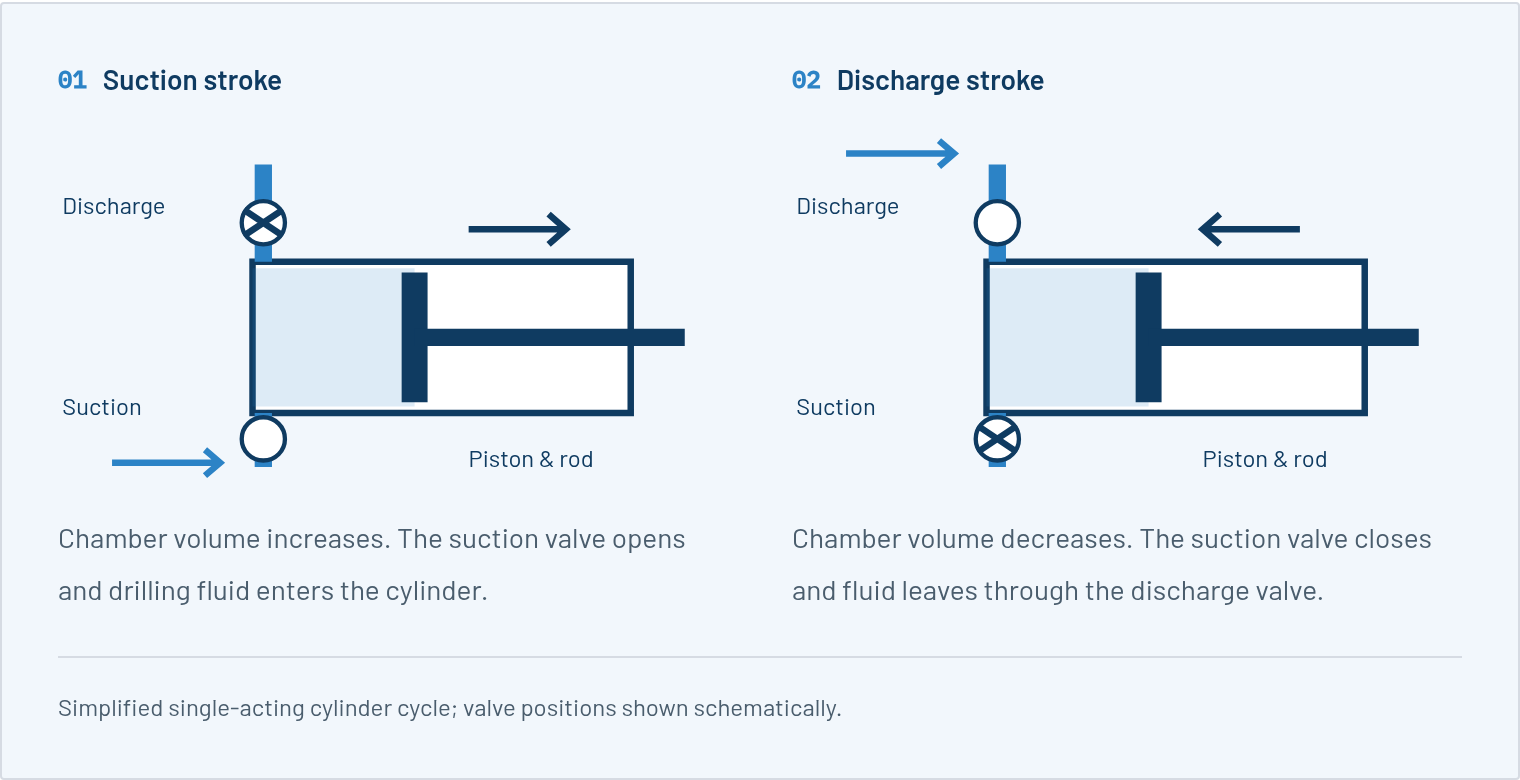
As the piston moves forward, chamber volume decreases. The suction valve closes, and the discharge valve opens when chamber pressure exceeds discharge-line pressure. Fluid is then pushed into the circulation system.
In a triplex mud pump, the three cylinders operate in staggered phases to reduce flow variation compared with a single cylinder. Pulsation dampeners help control pressure pulsations, but they do not eliminate the need for a correctly designed suction system.
Pump speed and displacement primarily determine flow. Discharge pressure depends on system resistance and must remain within the equipment ratings. A positive-displacement pump requires correctly specified pressure protection; never operate it against an isolated discharge.
Main Components of a Mud Pump
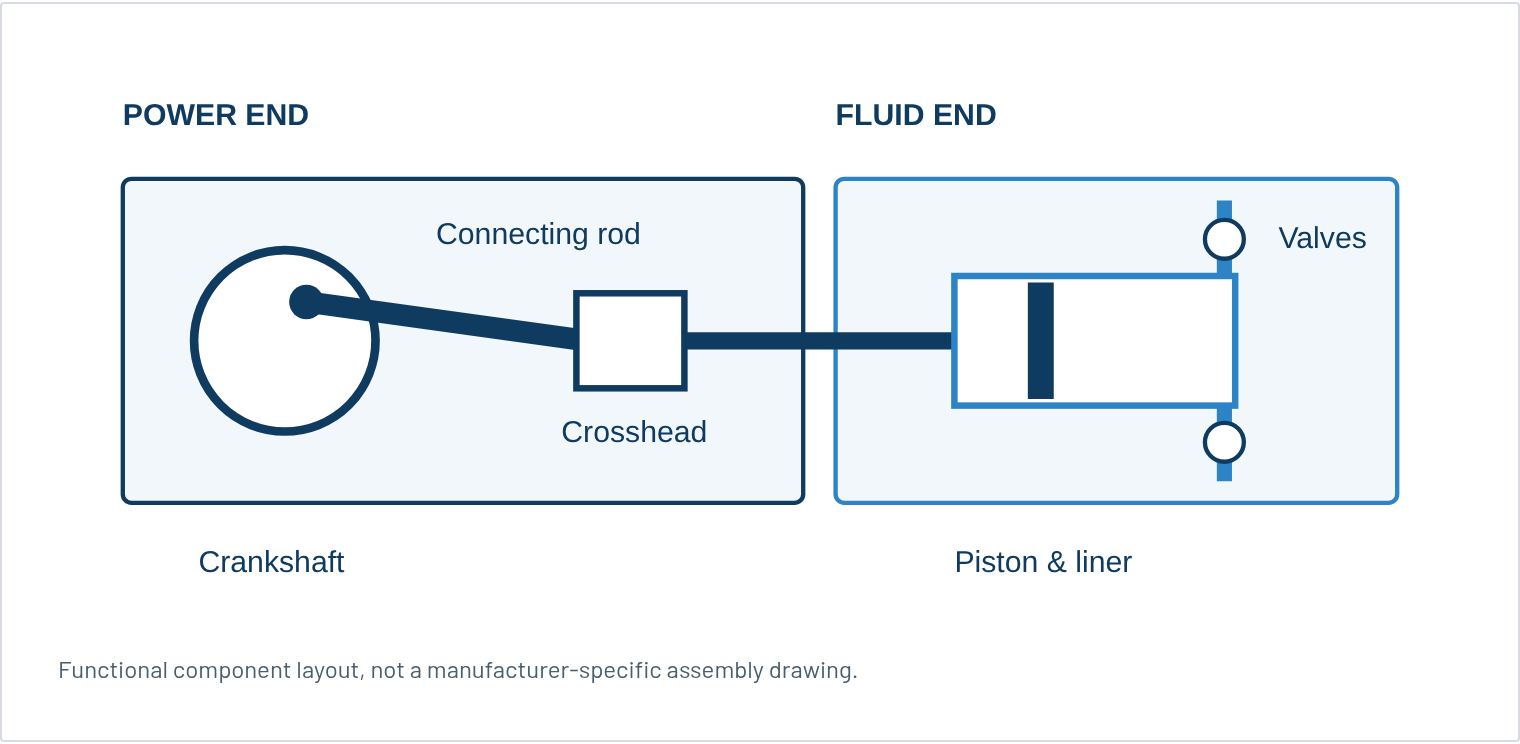
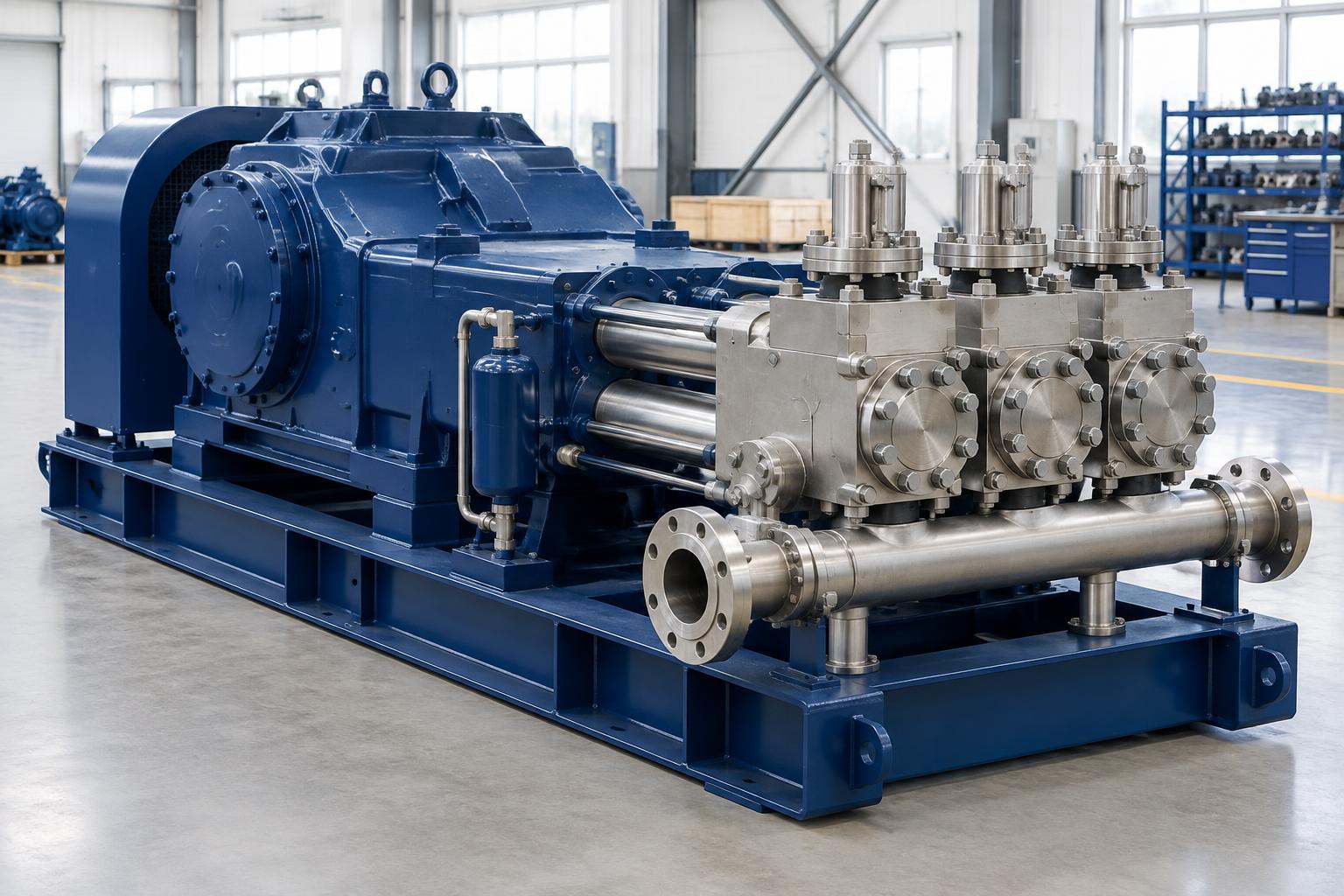
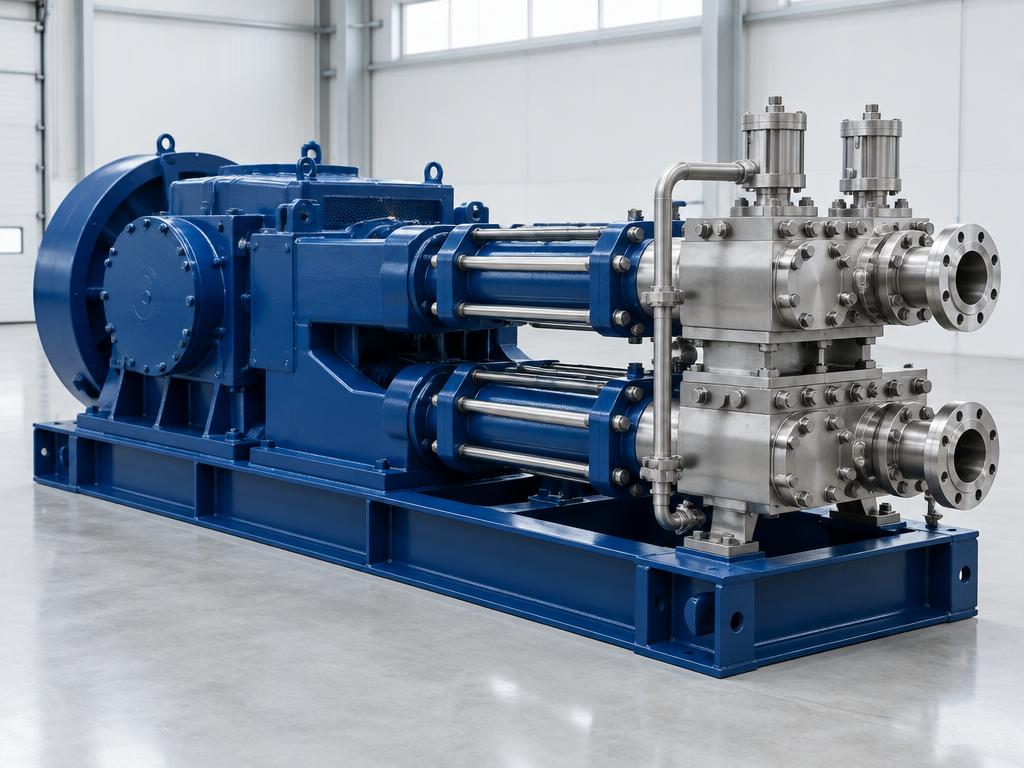
The main mud pump components are grouped into the power end and the fluid end. These assemblies work together, but they have different mechanical and maintenance functions.
Power end
The power end transmits drive power and converts rotation into reciprocating motion. Its main components include the frame, crankshaft, bearings, connecting rods, crossheads, and lubrication system. Correct lubrication and alignment are essential for reliable operation.
Fluid end
The fluid end handles the drilling fluid and operating pressure. It includes the fluid-end body or modules, liners, pistons or plungers, suction and discharge valves, valve seats, covers, seals, and manifolds. Parts exposed to abrasive mud require routine inspection and replacement as they wear.
Supporting equipment
Suction supply equipment, pulsation dampeners, pressure gauges, pressure-relief devices, and piston cooling or flushing systems support the pump package. Exact arrangements depend on the pump design and installation.
Types of Mud Pumps
Reciprocating mud pumps are often classified by cylinder count. Cylinder count alone does not define a pump's pressure rating or capacity; those depend on the manufacturer's design, liner or plunger size, stroke, operating speed, and available power.
Duplex mud pumps
Traditional duplex pumps have two cylinders and are commonly double-acting, delivering fluid on both forward and return strokes. They remain relevant in certain drilling applications and existing equipment fleets.
Triplex mud pumps
A triplex mud pump uses three cylinders and is commonly single-acting. This configuration is widely used in oilfield drilling, with a balance of circulation performance, maintainability, and package size.
Quintuplex mud pumps
Quintuplex pumps use five cylinders. Their phased pumping arrangement can provide smoother flow for suitable duties. Selection should be based on the required operating point and the specific equipment design, not cylinder count alone.
Applications in Oilfield Drilling
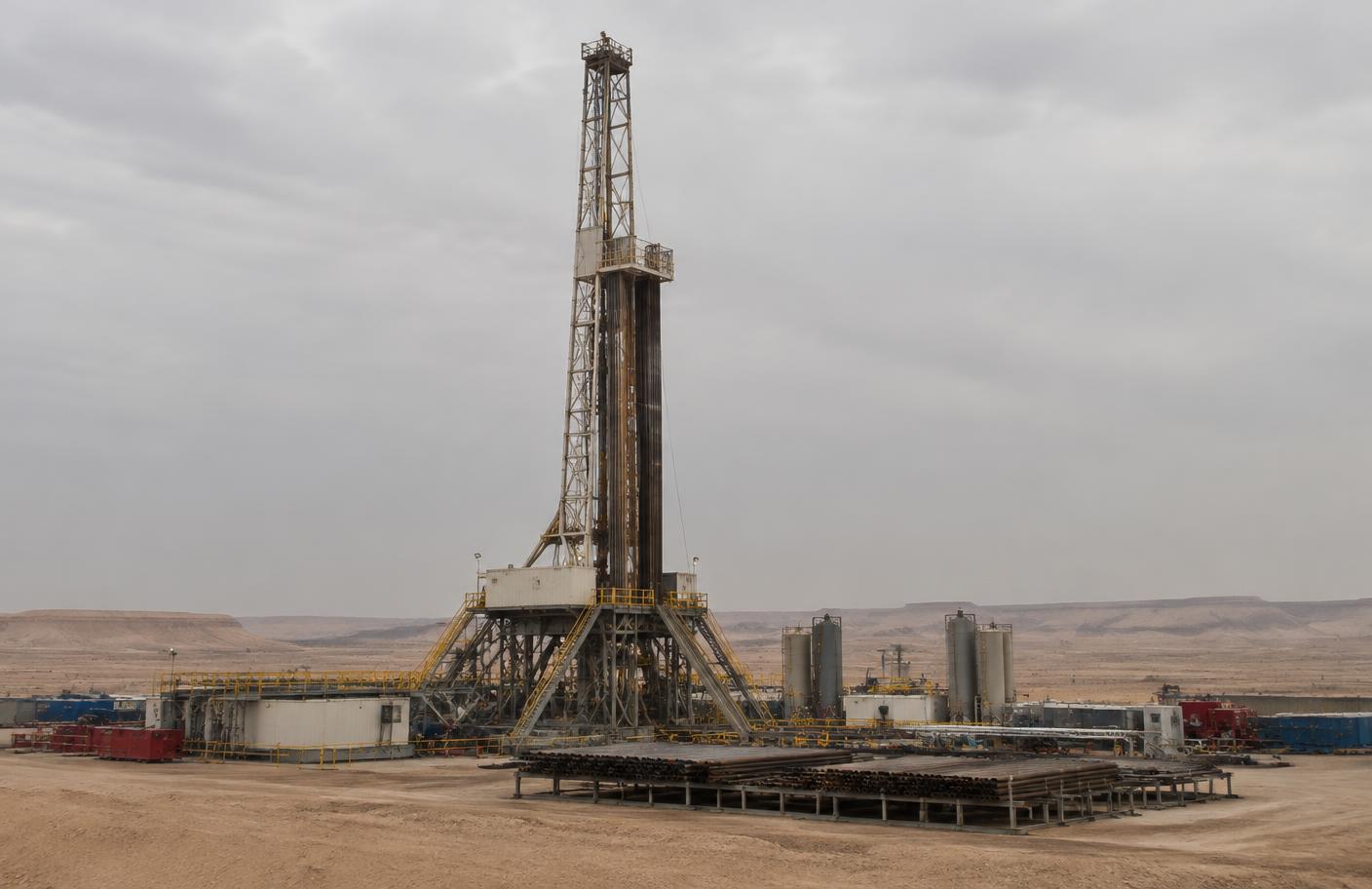
Mud pumps support both onshore and offshore drilling. Their circulation duty helps remove drilled cuttings, cool the bit, lubricate the drill string, and deliver hydraulic energy at the bit.
They also support circulation during well-cleaning and other procedures when the equipment and well program permit. Suitability for geothermal, mining exploration, or other drilling work depends on the pump configuration and fluid requirements.
Reliable operation depends on the entire mud system: adequate suction supply, suitable piping, solids control, fluid conditioning, and maintained pressure-protection equipment.
How to Select a Suitable Mud Pump?
Start with the drilling program and the hydraulic requirements. Specify the required flow rate and discharge pressure at the intended operating point, rather than treating maximum flow and maximum pressure as simultaneously available.
Hydraulic duty — required flow and discharge pressure at the same operating point.
Drilling fluid — density, viscosity, solids content, abrasiveness, and temperature.
Power & installation — available drive, footprint, suction arrangement, and site conditions.
Parts & documentation — compatible wear parts, maintenance access, drawings, and project requirements.
Confirm performance and compatibility
Check the manufacturer's performance data for the proposed liner or plunger size, speed, and drive power. Consider suction conditions, fluid characteristics, expected duty cycle, and any environmental limitations. Pressure-bearing components and connected piping must be compatible with the service.
Plan for maintenance and spare parts
Review access for inspection, lubrication requirements, and the availability of mud pump spare parts. For replacement components, verify pump model, part number, dimensions, materials, and drawings. Similar-looking parts are not necessarily interchangeable.
Ask the supplier to confirm applicable project documentation and inspection requirements. Do not assume a certification or performance rating applies without supporting equipment documentation.
Equipment & replacement parts
Recommended Mud Pump Products
Discuss your application or send existing equipment details to confirm a suitable option.
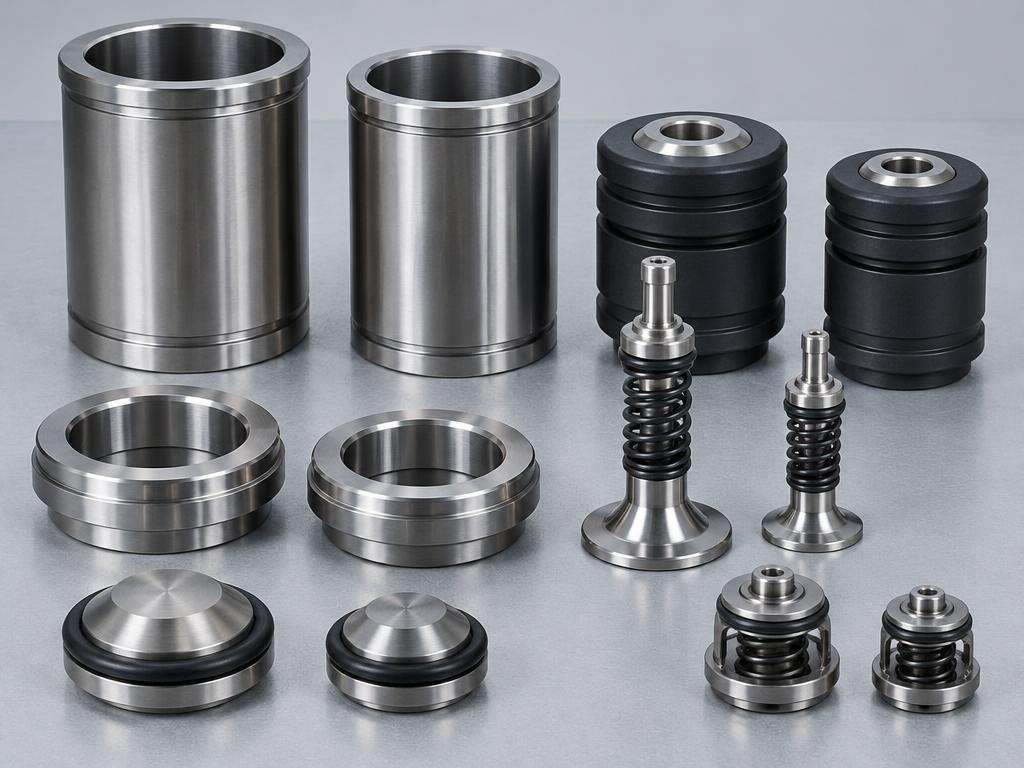
Mud Pump Spare Parts
Liners, pistons, valves, and wear parts matched to your existing pump.
Request a Quote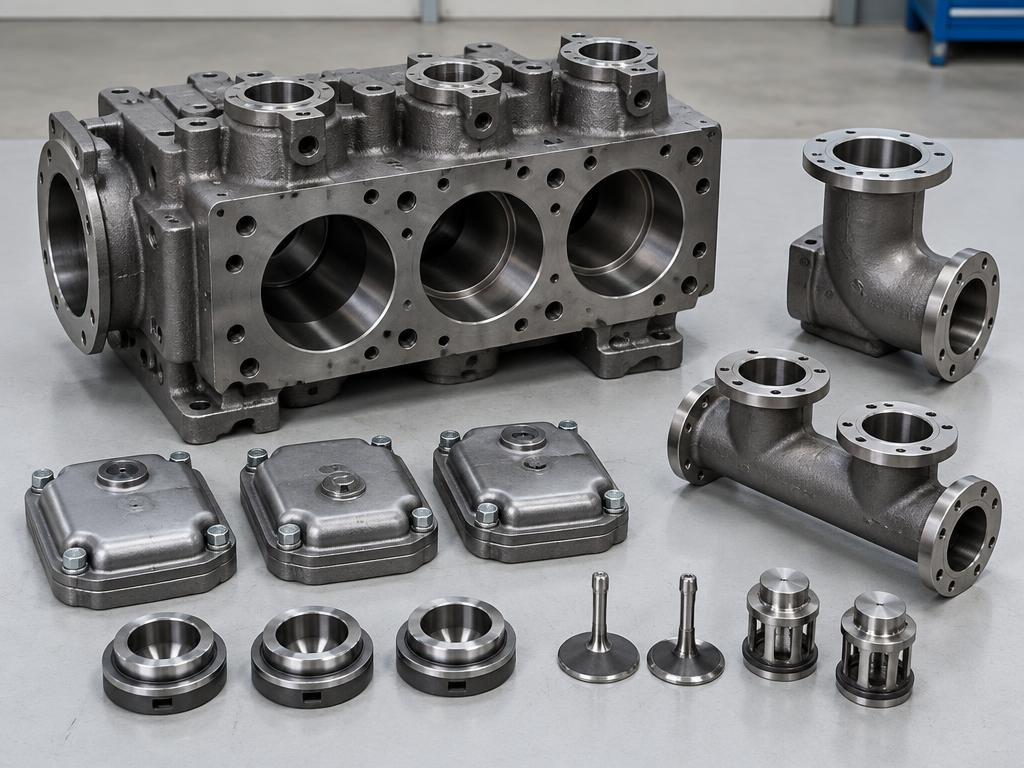
Mud Pump Fluid End Parts
Fluid-end components selected using pump details and part drawings.
Request a QuoteFrequently Asked Questions
What is the main function of a mud pump?
A mud pump circulates drilling fluid through the drill string and back up the well annulus. This circulation carries cuttings to the surface, cools and lubricates the bit, and supports wellbore stability. Fluid density provides hydrostatic pressure; pump pressure overcomes circulation losses.
How does a triplex mud pump differ from a duplex mud pump?
A triplex mud pump has three pumping cylinders and is commonly single-acting. A traditional duplex mud pump has two cylinders and is commonly double-acting. Their flow profiles, maintenance arrangements, and suitability depend on the specific design and drilling duty.
Which mud pump spare parts need regular inspection?
Inspect pistons, liners, valves, valve seats, seals, and fluid-end components according to the manufacturer's maintenance instructions. Wear depends on drilling-fluid abrasiveness, operating pressure, pump speed, lubrication, and suction conditions.
What causes pressure fluctuations in a mud pump?
Reciprocating pumps naturally produce pulsating flow. Excessive fluctuations can indicate worn valves or pistons, air entering the suction line, inadequate suction supply, or a pulsation dampener that needs attention. Follow the manufacturer's troubleshooting and safe isolation procedures.
What information should I provide when requesting a mud pump quotation?
Provide the required flow rate and discharge pressure at the intended duty point, drilling-fluid properties, available drive power, installation conditions, and any required documentation. For replacement parts, include the existing pump model, part numbers, and drawings where available.